
Rising electricity prices have made the operational efficiency of buildings one of the most important issues for their owners and managers. However, energy-related expenditure is just one area where savings can be sought. It is equally important to identify where unnecessary costs arise in connection with the operation of individual systems and what measures can help to reduce them. With this approach, facility management ceases to be merely the technical maintenance of a building and becomes a source of knowledge enabling more rational decisions to be made regarding its operation.
One of the fundamental problems associated with cost optimisation is the lack of detailed knowledge about how the building and its individual systems function. The energy bill alone does not answer the question of which appliances have the greatest impact on electricity consumption or where there are opportunities to reduce it. Therefore, one of the first steps should be to install appropriate metering systems in the building. This not only allows the total energy consumption to be determined, but also enables the operation of individual appliances and systems to be monitored. Only then can one assess where there is genuine potential for optimisation.
Sometimes it is enough to install sensors that allow you to check more precisely what individual appliances are doing and where some of the energy consumed can be recovered. In this way, potential savings can be achieved not on the basis of intuitive guesswork, but through collected data that allows the source of costs to be precisely identified, and on this basis, specific actions to be taken. “This represents a complete shift in the philosophy behind building operations,” says Marta Stańczak, CEO of SPIE Building Solutions.
The most obvious way to reduce energy consumption is to modernise equipment, for example by switching to LED lighting. But even in the case of solutions already considered standard, it is worth examining their actual efficiency. Older LED installations may be less efficient than systems currently available, which is why upgrading them may also be justified.
However, not every saving requires replacing a device. Sometimes the problem lies in how the equipment is used, its operating parameters, or when and at what intensity it operates. This applies particularly to premises where usage patterns vary throughout the day. In an office building, activity is usually much lower after working hours, which means that some parts of the system do not need to operate at the same intensity as during peak demand. Analysing how the equipment operates therefore allows us to identify opportunities to tailor its operation to the facility’s actual needs.
It is not only the efficiency of the equipment that determines costs
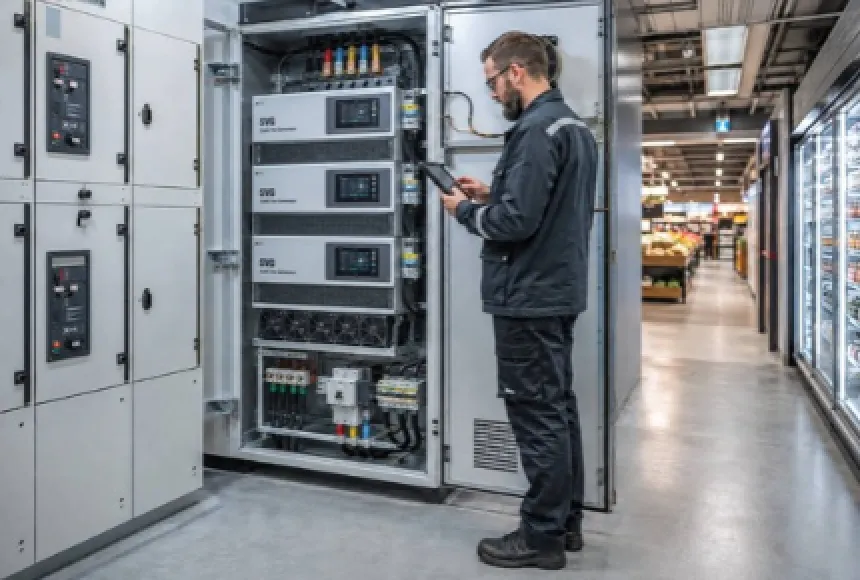
The role of facility management does not end with keeping equipment in good working order. The experience of technical teams also allows for a broader view of operating costs and the identification of areas that the owner or manager might not otherwise consider. One example of a solution that often helps to achieve savings relatively quickly is the use of reactive power compensators, which enable the efficiency of the electrical infrastructure to be increased and energy-related charges to be reduced.
When it comes to energy-related investments, one of the biggest challenges remains convincing the building owner to adopt a solution whose financial benefits are not immediately apparent. It is particularly difficult to make decisions when an investment requires an upfront cost, and the return on investment will only materialise after a certain period of time. This is why solutions whose effects can be measured relatively quickly are so important. In the case of power compensators, it is precisely the visible change in energy costs – on the basis of which financial simulations can easily be carried out – that helps to convince the customer to make greater use of this solution,” notes Marta Stańczak.
This does not, however, mean that every decision should be assessed solely in terms of a quick return on investment. Energy costs are just one aspect of a building’s operation. Modernisation can simultaneously improve the reliability of equipment and enhance user comfort, which in turn makes the building more attractive to tenants.
Furthermore, sources of savings may also lie outside the realm of the technical operation of equipment. Equally important may be the correct configuration of its operation, the way the infrastructure is utilised, or even an analysis of the terms on which energy is supplied. Professional technical expertise can be helpful in identifying savings by negotiating a lower energy transmission tariff, as – though this is not always obvious to a building manager – purchasing services at a higher tariff is often unnecessary.
The greatest savings can stem from simple observations
Optimising a building does not always require spectacular modernisation. Sometimes, analysing how the infrastructure currently operates yields clear results: which devices are running and when, how much energy they consume, and whether their operation meets actual needs. But the issue of systematic maintenance is also important. Reducing the frequency of certain maintenance tasks may appear to result in savings, but it can sometimes have the opposite effect in the long term. For example, improper maintenance of filters in air-conditioning systems can lead to higher energy consumption and, consequently, increased costs.
Therefore, effective cost management should not rely on mechanically cutting expenditure on technical maintenance. It is crucial to identify which types of work generate costs now but help avoid greater costs in the future, and which can genuinely be optimised without compromising the building’s functionality. Facility management activities play a particular role in this process, as they are carried out in close proximity to the infrastructure in daily operation. The technical teams responsible for these tasks observe how equipment performs in practice, can compare data from different periods and sites, and identify areas where an investment or a change in operating procedures could yield measurable results – concludes Marta Stańczak.
Saving money in a building does not, therefore, have to start with the question: ‘What should be replaced?’. In many cases, a better starting point is to find the answer to the question: ‘What actually generates the cost, and why?’. Working with professional technicians who have practical experience in this field allows you to decide whether any modernisation, changes to operating parameters, additional metering, or perhaps an adjustment to the energy billing method itself is required.