Q&A: Artur Myca, Senior Designer in the Design and Analysis Division at SPIE Energotest
How many years have you worked at SPIE Energotest?
My career path started 17 years ago at Energotest, which then became part of the SPIE Group as SPIE Energotest. It can therefore be said that I have been working in this structure since the beginning of my career.
What is your job title and what do you do? What are your main responsibilities?
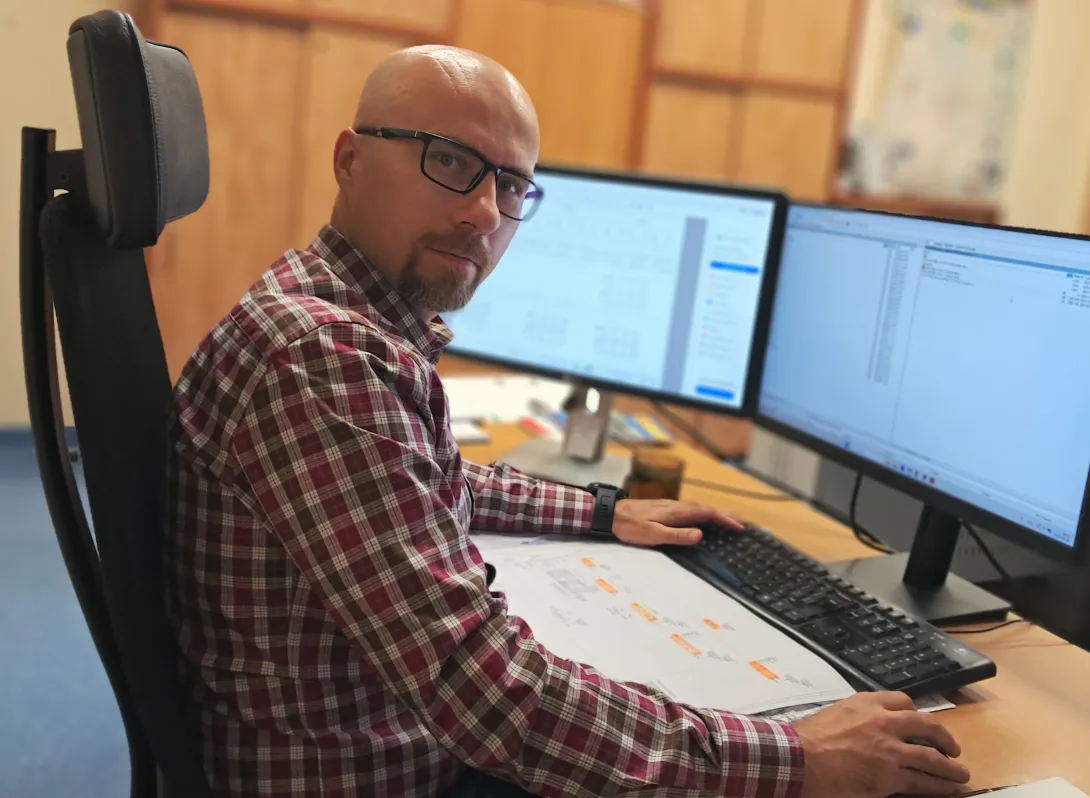
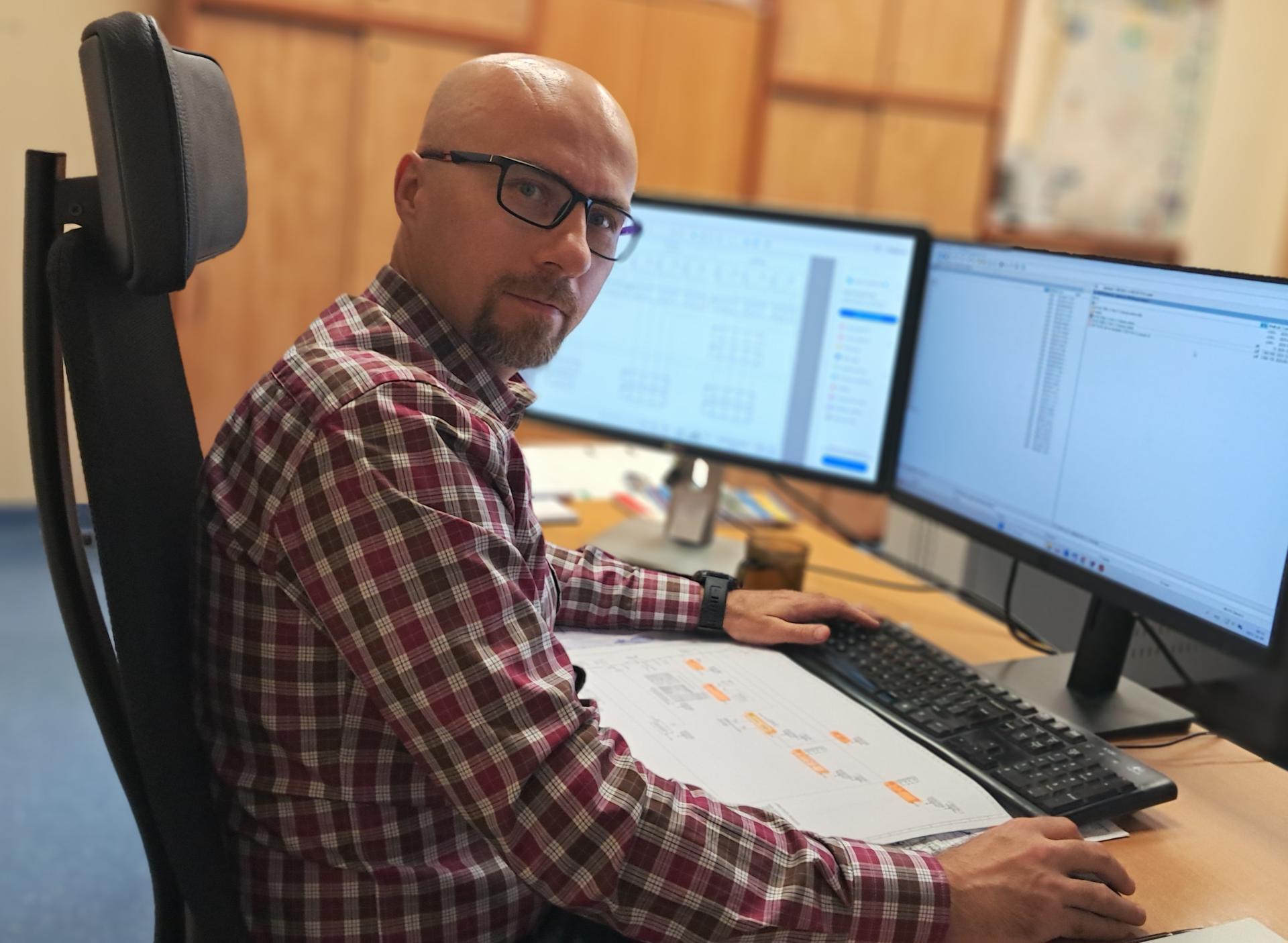
My name is Artur Myca, at SPIE Energotest I work as a senior designer in the Design and Analysis Division.
Two aspects are of equivalent importance in my area of responsibility.
On the one hand, I am involved in the development of complete detailed designs of the electrical branch with particular emphasis on the design of secondary circuits of HV substations. This aspect encompasses the complete engineering cycle, from technical concepts, analysis and calculations, selection of apparatus and equipment to the development of basic and assembly diagrams.
On the other hand, I act as project manager during the implementation of multi-discipline design documentation for T&D facilities under construction and modernisation. In this role, I coordinate the work of designers from other trades, ensuring that all elements of the task are consistent. I lead arrangements with the client so that the solutions we design meet expectations while complying with current regulations and industry standards. I manage the key business aspects of the task - overseeing the budget and schedule.
All of these activities form the basis of effective project delivery.
How did your adventure with SPIE begin?
My adventure with SPIE started when the company Energotest, where I had worked since the beginning of my career, became part of the SPIE Group.
It was not a classic start in a new place, but rather a kind of transformation. The experience I had gained previously and the competences I had developed opened up to the new opportunities that joining the SPIE Group offered .
What does your typical working day look like?
My typical day at SPIE Energotest is rarely 'typical'. Designing for the electricity sector especially during the energy transition requires constant flexibility and quick responses.
I usually start my day by analysing email correspondence and assessing which topics require immediate intervention and which require planning.
Then, I spend time coordinating the work of the project team to ensure the project process runs smoothly and on schedule. This is a key part of the day.
Then I move on to complete my own tasks. Most often I work on the detailed design of secondary circuits. This allows me to use my skills and develop my experience.
What skills are needed in your job?
As I said at the beginning, my responsibilities are shaped by two aspects. This naturally results in the need for two sets of skills that allow for a smooth transition between the role of designer and coordinator of a multi-discipline task.
On the one hand, communication skills that allow for efficient agreement of assumptions and acquisition of input from the client, as well as subsequent coordination of work with partners and the SPIE Energotest team.
On the other hand, technical knowledge that allows for proper assessment of the correctness of the designed solutions.
With whom do you most often work (e.g. clients, subcontractors, SPIE colleagues, etc.)?
My role requires interaction with virtually all participants in the investment process.
First and foremost are the clients with whom I carry out technical arrangements and obtain key inputs to projects. In the case of multi-discipline assignments, it is equally important to work with our subcontractors who develop documentation for trades other than electrical. When the project enters the implementation phase then contact with the contractor becomes necessary. Of course, in all of this cooperation within the SPIE project team is indispensable so that the result of our work is a coherent and coordinated project documentation.
What challenges do you encounter at work?
Challenges are an integral part of the work in probably every design office. In order to cope with them we often have to step outside of our comfort zone, it is important to see this as an engine for growth.
One of the biggest challenges is the need to constantly adapt to the rapidly changing energy sector especially now that we are going through an energy transition. Our projects are inherently engineering complex, compounded by the need to strictly adhere to changing regulations and industry standards. This requires not only technical expertise, but also the flexibility to quickly implement new requirements into detailed designs.
The second area that is undoubtedly challenging is ensuring that projects are delivered at the right pace. It is extremely challenging to balance tight schedules with the need to ensure maximum accuracy and correctness of technical solutions. This allows us to maintain the high quality and punctuality of service to which our clients have become accustomed.
What do you like most about your job?
I consider design to be somewhat of a creative job. So I like to be an active observer and participant in the process by which something is created.
The most fascinating thing for me is how we start with a "blank sheet of paper" - i.e. an idea, an abstraction - and over time, thanks to our knowledge and the collaborative work of the design team, this concept takes real, technical shape. What was in the realm of an idea becomes a finished detailed design and the starting point for the final realisation of the investment.
The wide range of projects that we carry out in the Design and Analysis Division at SPIE Energotest is also extremely important. From 0.4 kV switchgear to medium voltage to high voltage, as well as a variety of conceptual work and analysis - this wide range of work allows me to continuously gain experience and develop my competence in a number of specialised areas.
Do you have an interesting story related to your work?
Do I have an interesting story? In our industry, an 'interesting story' most often means a serious technical problem that you have miraculously managed to get under control. That's half joking - half serious. I am unlikely to have a story straight out of an action movie.
In my opinion, an interesting story from today's point of view could be the fact that my career path has been uninterrupted for 17 years in the same structure. This gives me a unique perspective and provides a continuity of experience that I can use in my day-to-day professional work.
Has the profession changed over the years? If so, how has it?"
It certainly has, although to say what kind of change it has been one would have to define some kind of time frame. The biggest fundamental revolution in the design industry took place some time ago, with the advent of computer-aided design (CAD) tools.
In recent years, on the other hand, the changes have been more methodological and dictated by market requirements.
A major change has certainly been the move to more advanced and integrated design software such as EPLAN. This change has significantly increased the efficiency and quality of our projects.
The second aspect is the changes in the direction of the industry as a whole. When I started work, many projects were for the generation sector in terms of building new or upgrading existing, coal-fired generating units. We are now in the midst of an energy transition, which directly affects the nature of projects. We are focused on the T&D sector and are adapting it to co-exist with emerging renewable energy-based generation sources.
What education or courses are needed to work in this profession?
A combination of solid fundamentals and continuous specialisation is needed. It is therefore essential to have a degree in electrical engineering, but also in related fields such as automation or electronics and telecommunications. A degree in this field provides the fundamental engineering knowledge that is essential.
A diploma alone is only the beginning. It is also important to have the relevant design qualifications that formally enable you to perform independent functions in the construction industry. In addition, ongoing training in the use of specialised software is essential.
What would you advise a person who wants to start working in this profession?
Working in a design office can be very rewarding, but it requires a specific approach. First of all, communication and teamwork are important - projects are complex, and without the ability to clearly communicate ideas and coordinate activities, it is difficult to achieve the desired results. Secondly, a solid foundation of engineering knowledge is crucial; continuous training in the latest standards and technologies is a must in our industry.