
With heatwaves becoming increasingly frequent, ventilation and air-conditioning systems in office buildings are operating under a much greater load than they were just a dozen or so years ago. Employee comfort is no longer determined solely by the efficiency of the equipment, but also by how their operation is managed, appropriately selected schedules, the use of building automation and regular servicing. Proper operation helps to reduce energy consumption, minimise the risk of breakdowns and maintain stable working conditions even on the most demanding days.
High outdoor temperatures mean that HVAC systems operate almost continuously for many hours. Modern office buildings with large areas of glazing are particularly challenging, as solar radiation results in significant heat gain, which the system must continuously dissipate. We are increasingly seeing situations where systems designed over a dozen or so years ago are unable to maintain the required comfort parameters during heatwaves lasting several days. This is because many buildings were designed based on historical climate data, when temperatures exceeding 35°C were rare in Poland. Nowadays, such temperatures are practically an annual occurrence. For this reason, it is becoming increasingly important to allow for an adequate power reserve, ensuring that the system does not operate at the limits of its capacity for many days on end.
However, it is not only the outdoor temperature that affects the load on the system. The building’s design, the number and size of glazed areas, its orientation to the cardinal points, the lighting used and the number of people present in the rooms are also significant factors. All these factors are taken into account during the design of HVAC systems, as they affect the amount of heat the system must remove to maintain the required air parameters.
– These days, temperatures above 30°C occur much more frequently than they used to. Therefore, when designing such systems, it is essential to ensure there is sufficient power reserve. But it is equally important to control the system’s operation properly, as incorrect settings can lead both to increased energy consumption and accelerated wear and tear on components – says Bartłomiej Bogacz, project manager at SPIE Building Solutions.
From an operational perspective, one of the most common problems is designing systems with a minimal cooling capacity margin. During periods of normal temperatures, the system functions correctly; however, during heatwaves lasting several days, it runs practically non-stop, which results in higher energy consumption, faster wear and tear on compressors, and difficulties in maintaining thermal comfort.
Staff comfort depends on proper control of the system
During hot weather, setting the room temperature as low as possible seems like the intuitive solution. In practice, however, this does not result in greater comfort, whilst it significantly increases the load on the entire refrigeration system. Much better results are achieved by maintaining the temperature within the range of 23–26°C and avoiding too great a difference between the indoor and outdoor temperatures, which should be around 4–6°C. This ensures the system operates more stably. Lowering the set temperature from 24°C to 21°C can increase the demand for cooling energy by as much as several to several dozen per cent, depending on the building’s characteristics. In practice, it is more cost-effective to maintain stable parameters than to attempt to rapidly cool a building that has already heated up.
– It is also very important to prepare the building properly before the hottest weather arrives. Rather than trying to cool down a building that has already heated up, it is better to gradually lower the temperature in advance, based on weather forecasts or predictions from predictive systems. Roller shutters and automatic shading systems also help to reduce the load on the system by minimising the amount of solar energy entering the building. As a result, the cooling system can operate more evenly, without a sudden surge in power demand – points out an expert from SPIE Building Solutions.
Modern buildings are increasingly using BMS systems, which enable the scheduling of system operation for individual zones. This allows air conditioning to be activated only where occupants are actually present. Properly configured schedules reduce unnecessary energy consumption whilst ensuring comfort from the start of the working day. Increasingly, these solutions are being supplemented with predictive control functions that utilise weather forecasts, building occupancy analysis, control of façade blinds and data from CO₂ sensors. This allows the building to be cooled even before the peak heat sets in, thereby reducing peak power consumption and improving occupant comfort.
Ventilation, air conditioning and building automation must operate as a single system
Although the terms ‘ventilation’ and ‘air conditioning’ are often used interchangeably, the two systems perform different tasks. Ventilation units are responsible for supplying fresh air and removing stale air, whilst air-conditioning units maintain the set air parameters, including temperature and humidity. In practice, it is only through the combined use of both solutions that suitable conditions inside the building can be ensured.
The design of such systems requires consideration of many factors affecting the building’s heat balance. The number of people present in the rooms, the amount of heat and moisture they generate, the function of individual zones, the lighting used and the area of glazing are all analysed. In rooms intended for continuous human occupancy, the required thermal comfort and humidity parameters are also taken into account, as these affect both the well-being of the occupants and the subsequent operation of the entire HVAC system.
Regular servicing helps maintain efficiency and reduce costs
Even the best-designed system will not operate efficiently without proper maintenance. Basic tasks include cleaning heat exchangers, replacing filters, checking the parameters of refrigeration units, testing freon systems for leaks, and verifying the operation of the control systems.
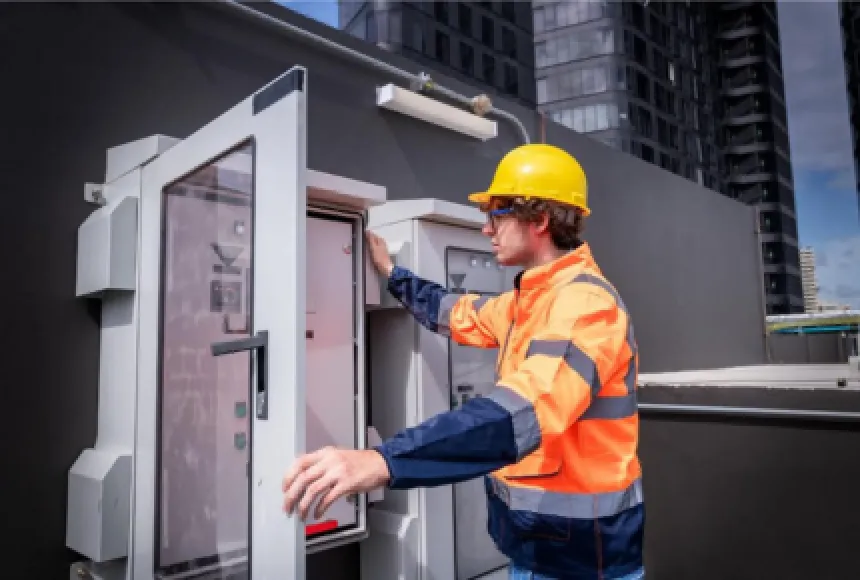
– Outdoor units installed on roofs require particular attention, as they are exposed to dirt that reduces the efficiency of the heat exchangers. If dirt is not removed regularly, the units require more energy to achieve the same cooling results, and their components operate under greater strain. This increases the risk of costly breakdowns, and the cost of replacing a compressor can be comparable to buying a new unit – warns Bartłomiej Bogacz.
The frequency of inspections should be tailored to the operating conditions of the specific building. In some buildings, the standard two inspections per year may prove insufficient, which is why it becomes necessary to increase the frequency of servicing. This not only helps to reduce energy bills, but also extends the service life of the most expensive components of the system and reduces the risk of costly breakdowns during periods when the system is operating at peak capacity.
In the face of increasingly frequent extreme temperatures, effective management of HVAC systems is no longer merely a matter of user comfort. It is becoming one of the key elements of a building’s energy efficiency, operational safety and the reduction of property maintenance costs.