
Annual water demand in the European Union currently stands at around 140–200 billion m³. At the same time, human activity already accounts for between 10 and 50 per cent of the available freshwater in European river basins, according to an analysis by the European Commission’s Joint Research Centre (JRC). Forecasts indicate that, as climate change progresses, the availability of these resources in many regions of the continent will gradually decline, which will increase the pressure on the economy and technical infrastructure.
World Water Day, which falls on 22 March and was established by the UN in 1992, is an opportunity to highlight the importance of sustainable water management. Meanwhile, an increasing number of countries are experiencing so-called ‘water stress’. This term refers to a situation where the annual volume of renewable water resources per capita falls below demand, which in this case is 1,700 m³ (according to UN calculations). Poland falls into this category.
Poland among the EU countries most at risk of water scarcity
Hydrological statistics place Poland among the European Union countries with the lowest availability of fresh water. Only Malta and Cyprus have lower per capita water resources. According to the Central Statistical Office, the average amount of renewable water in our country is approximately 60 billion m³ annually; however, during periods of drought, this figure falls below 40 billion m³. This high volatility, exacerbated by the uneven distribution of rainfall, generates constant water stress. This is particularly evident in the southern regions, where periods of water scarcity are often interspersed with sudden rises in water levels and floods.
These shortages are directly reflected in companies’ operating costs. In 2026, the average price per 1 m³ of water in Poland exceeded the 10 zł mark, whereas in 2025 it was still 5–7 zł.
– With availability ratios falling in recent years to 1.1–1,600 m³ per person, the industrial sector is faced with the need to optimise water consumption in order to maintain profitability. This situation is forcing a shift away from a model of unrestricted consumption towards rigorous management of every litre of water used in technological processes – notes Dorota Włodarczyk-Strugalska, project group manager at SPIE Building Solutions.
The efficiency of water systems as a source of real savings
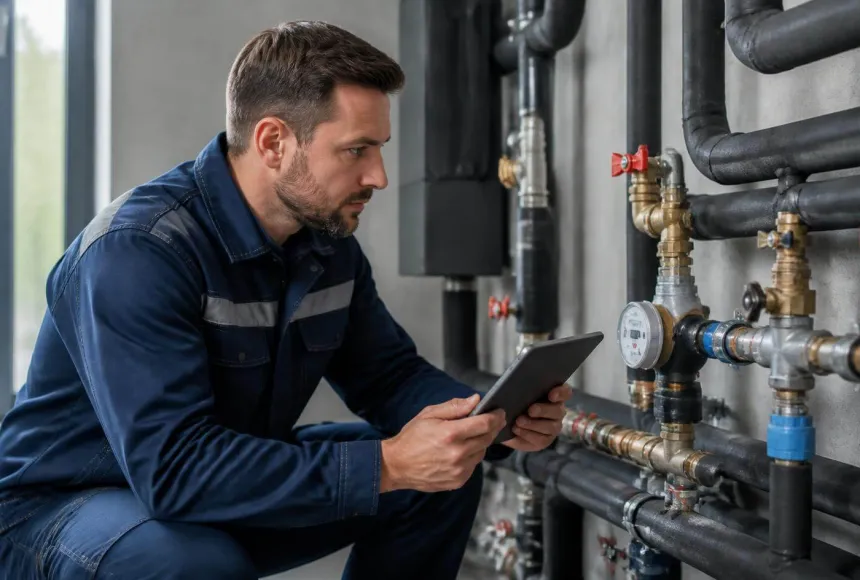
In industrial and office buildings, where daily water demand is measured in hundreds of cubic metres, every unit of water saved has a tangible impact on profitability. The greatest potential for optimisation lies in closed-loop water circuits that supply cooling and heating systems. In these systems, the physico-chemical parameters of the circulating fluid directly translate into the operational costs of the entire facility.
The correct implementation of advanced technical preventative measures can reduce these costs by an average of 10 per cent. Professional monitoring of process water quality helps to minimise the need for frequent discharge of circulating water, even if only to remove accumulated deposits. This results in lower water consumption from the mains supply.
At the same time, rigorous monitoring of heating and cooling water parameters, together with scheduled maintenance of water treatment equipment, prevents corrosion, mineral crystallisation and the formation of boiler scale. Boiler scale, acting as a thermal insulator, drastically impedes heat exchange, which forces boilers to work harder and may result in, amongst other things, increased electricity consumption or a higher likelihood of system damage and leaks.
Similarly, corrosion in refrigeration systems also poses a serious threat to system efficiency. This process leads to damage to pipework, a drop in efficiency and an increase in operating costs.
– Water quality control and regular servicing of the antifreeze fluid in cooling systems can – provided the appropriate operating conditions are met – increase the efficiency of heat exchangers by up to 25 per cent. This is an investment that reduces the risk of pump or condenser failures, the repair of which often involves expenditure in the region of several tens of thousands of zlotys – points out Dorota Włodarczyk-Strugalska.
In a world of growing water scarcity, efficient water cycle management is becoming a strategic element in mitigating a company’s risks and costs. Adherence to precise technical guidelines is the key to ensuring trouble-free operation of the system and the predictability of expenditure. The Polish standard PN-C-04607:1993 and international standards, such as VDI 2035 (for heating systems) and VDI 3803 (for cooling systems), define the quality parameters that must be met to ensure stable operating conditions for equipment.
A strategy based on optimising the efficiency of water systems can help to reduce both the direct costs of purchasing water and energy, as well as limit the plant’s environmental impact. Investing in professional process water monitoring represents an annual cost that is incomparably lower than the cost of rectifying the consequences of breakdowns resulting from negligence.
In the era of the energy transition and growing pressure to report on environmental initiatives, ensuring the good condition of water systems is becoming an increasingly important demonstration of responsible and modern infrastructure management.